

Know your net worth.
Keep on track.
Add what you own and what you owe. We turn those numbers into a trend over time so you can see where you've been and where you're headed.
No credit card. No bank login. No catch.
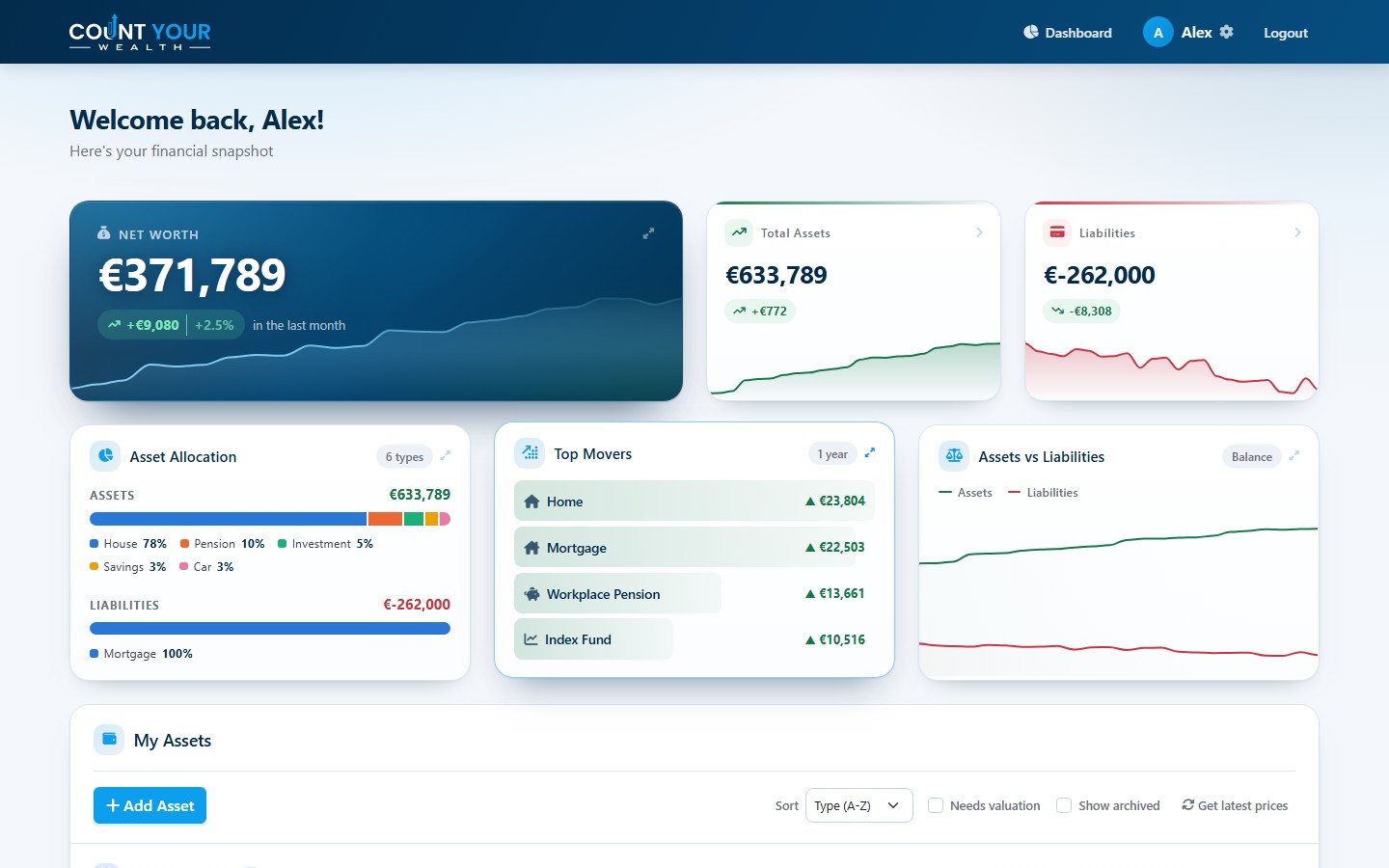
This is the whole app
Hate when websites don't show you what you'll get? Have a look below.
The important line
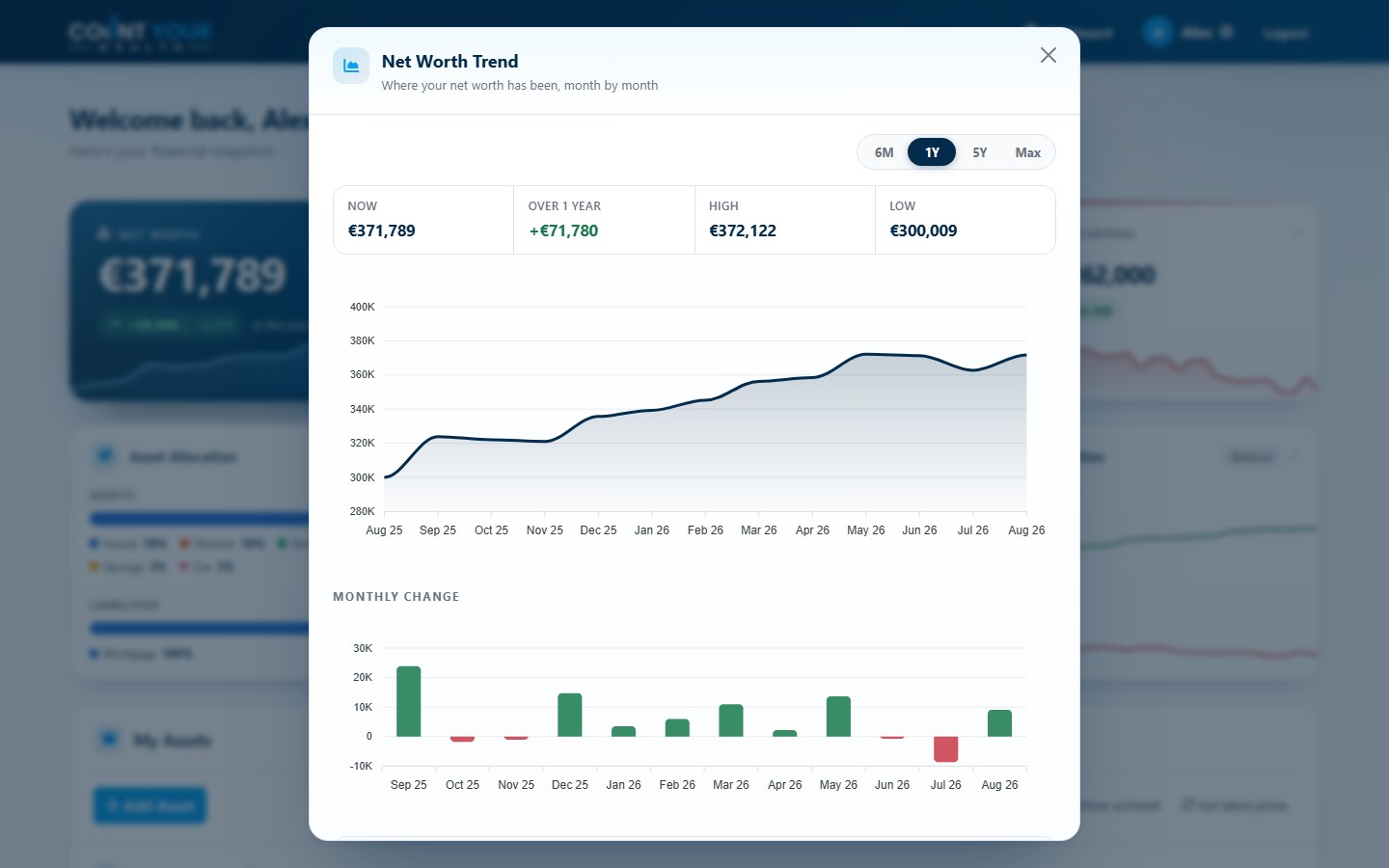
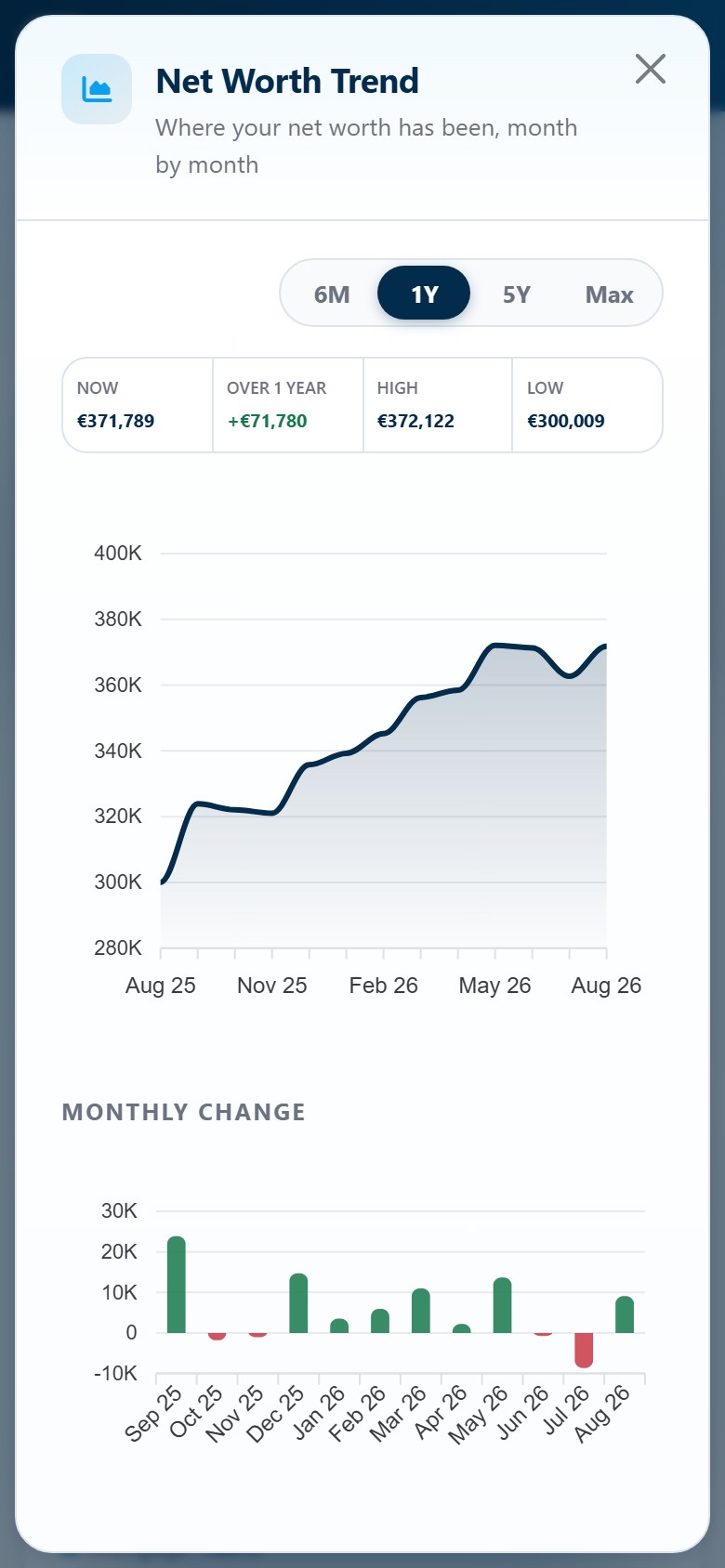
Follow your money journey. When you bought a house, or saved for that holiday. Switch between six months, a year, five years or everything you've ever recorded, and see each month's change laid out beside it.
- Month-by-month change, up and down
- Highs, lows and totals for the period you pick
- Every value you've ever entered is kept
Break it down
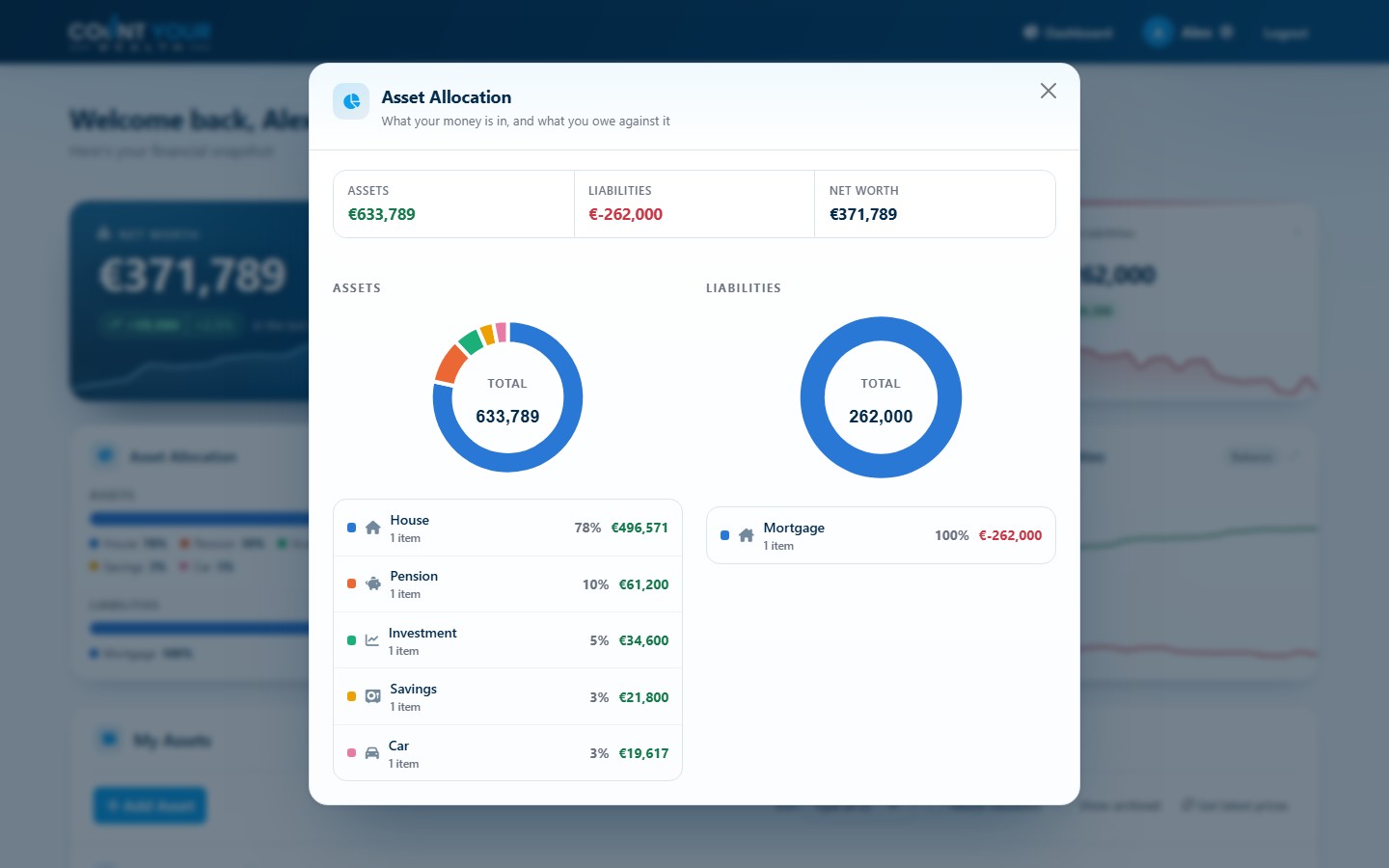
Where does your wealth sit? Where does your debt sit? Allocation splits your assets and your debts by type, so you can see where you're at.
- Assets and liabilities broken out separately
- Share of the total for every category
- Top movers: what shifted, and by how much
Each asset has its own story
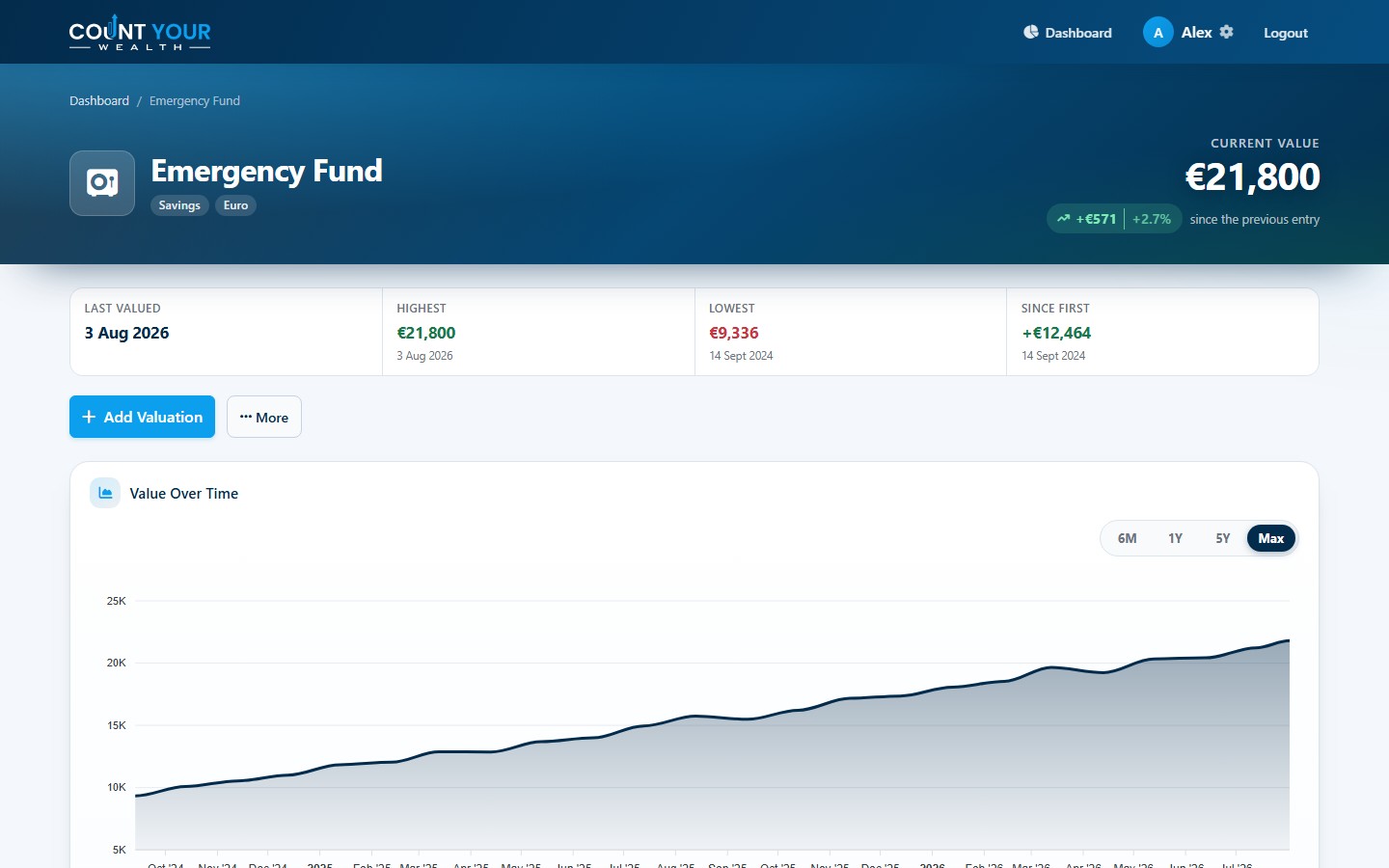
Dive into the detail of a single asset and see how it has changed over time. Open anything you track and you get its full history - when it was last valued, its highs and lows, and how far it has come since the first entry you made.
- Add a valuation in a couple of taps
- Import a spreadsheet of past values, or export yours
- Shares and funds can price themselves from a ticker
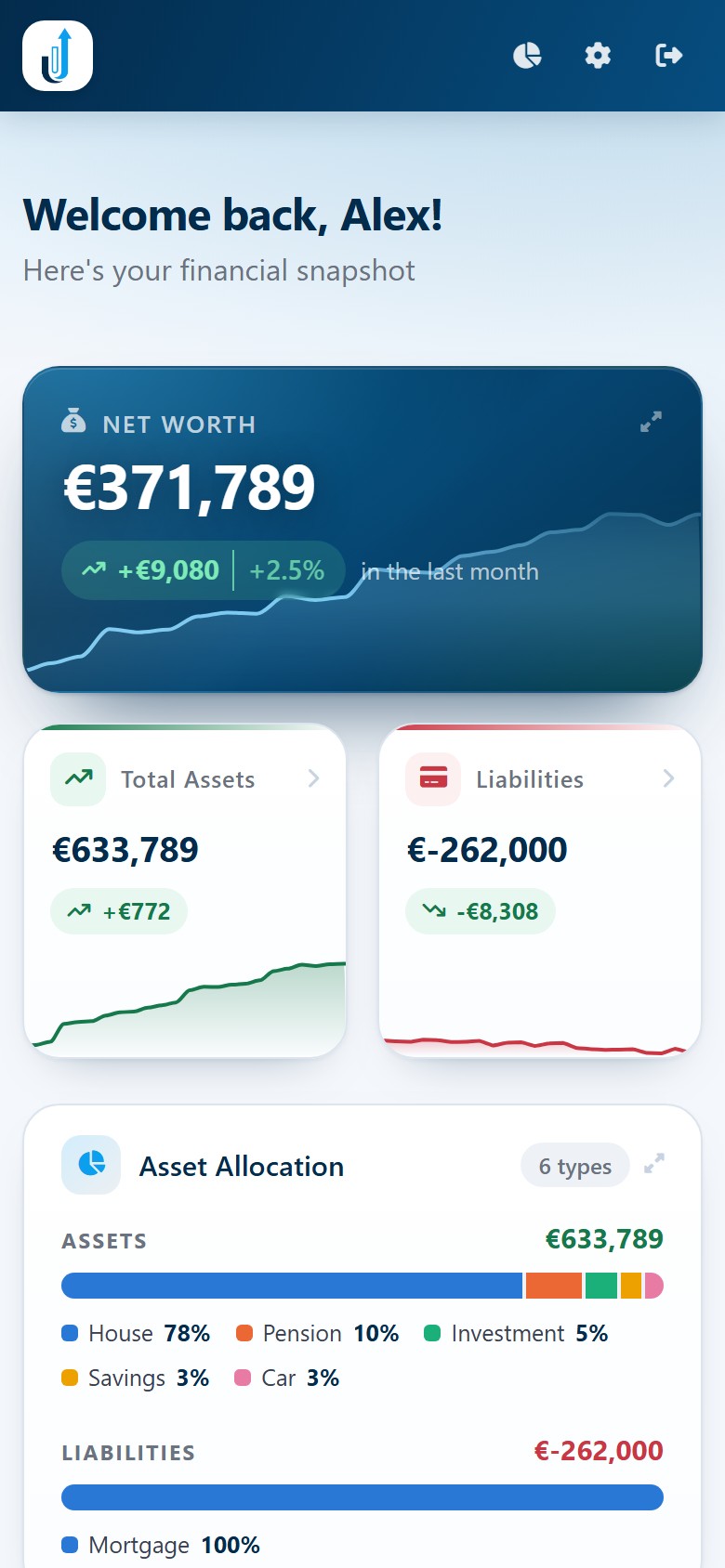
Built for your phone
Updating your net worth is meant to be easy. It's a five-minute job once a month, usually on the sofa. Every screen is designed for a thumb first - the same app, the same data.
Try it on your phone
Three steps. That's it.
You already know what you own. You're just writing it down.
Add what you own and owe
House, car, savings, pension, crypto, the mortgage, the credit card. Anything with a number attached.
Record its value
Whenever suits you. Monthly works well. Estimates are fine but you can get down to the penny if you're keen.
Watch the trend
After a few months the shape appears, and you can start making informed decisions.
What you get, and what we'll never do
We built this because spreadsheets are a pain and sometimes you don't need a site to do everything.
What you get
- Every feature, free. No tiers, no trial, no card.
- Full history. Every value you record is kept, for as long as you want it.
- Any currency. Hold a stock in USD and savings in EUR, totalled in whichever currency you fancy.
- Your data, portable. Import a spreadsheet or export the lot.
- Delete means delete. Close the account and it's gone immediately.
What we'll never do
- Ask for your bank login. There is nothing to connect. You type the numbers.
- Sell or share your figures. They say if it's free you're the product, but in this case, it's just free.
- Show you ads. We don't want that. You don't want that.
- Nag you to upgrade. There's nothing to upgrade to.
- Bury you in features. No budgets, no categories, no AI advice.
If it has a value, you can track it
Twenty-odd asset types out of the box - and "Other" for whatever we've missed.
Each asset keeps its own currency. Totals are converted to your favourite one, using rates from the day you recorded the value.
The questions you want to ask
Who built this, and why?
Hi. It's me. The guy who made it. I'm out in New Zealand hating spreadsheets. I had one for 10+ years and I can't be done with it any more. I just wanted a basic net worth tracker that I would write my numbers into every month and see what direction I was going in.
So I built this and then figured I might as well share it with you all. I find it really handy. I hope you do too.
Is it actually free, or free-for-now?
Free.
To be honest there's no real business model here. I believe that financial literacy is important, and this seems like an easy way to give back. If it changes I'll give you the opportunity to bounce. You already can, at any time.
Why won't you connect to my bank?
A couple of reasons. Holding your bank details is a risk we don't want to have over here at Count Your Wealth Towers. Banks get itchy about it, governments get itchy about it and people keep trying to get it. Also, banks charge a fortune to talk to them. So let's leave it alone.
Most importantly though, typing the numbers yourself keeps you in check with what you really have. Write down that number. Own it. If you update automatically you run on autopilot, and the whole point of the site is to check in with where you're at.
How do you make money, then?
We don't! For those interested - hosting and the database cost around NZ$50 a month. We pay for that out of the goodness of our hearts.
Can I get my data back out?
Yes - export everything to a spreadsheet whenever you like. One asset or all of them, it's your data. You can import assets too. Pretty handy if you have a bunch of data like I did.
What if my assets are in different currencies?
Too easy. Each asset has its own currency, and your account has a preferred currency. We convert other currencies into that using exchange rates on the day you valued the asset.
How often should I update it?
Monthly or quarterly suits most people. Keeps you honest but it's not a chore. There's a whole guide on finding your rhythm in our Wealth Library.
Can I delete my account?
Yes, from your settings at any time. And we'll purge every trace of you immediately. Sorry to see you go though.
Tracking is a tool, not a goal
Short reads on the why behind the numbers - and what wealth actually means.
Net Worth Isn't the Point - Life Is
Money is a tool. Family, experiences and freedom are the goal. Why tracking still serves the things that matter most.
Read the guideWhat Is Net Worth and Why Does It Matter?
A jargon-free explanation of what net worth means, how to work it out, and why it's the most useful number you can track.
Read the guideThe Difference Between Wealth and Being Rich
A high income doesn't make you wealthy. This distinction is one of the most important financial realisations you can have.
Read the guideTypes of Net Worth: Liquid, Illiquid, and Why It Matters
A million dollars in a house you can't sell is very different from a million in a savings account.
Read the guideHow Often Should You Track Your Net Worth?
Too often and it becomes noise. Too rarely and you lose the thread. How to find a rhythm that works.
Read the guide